
Refactoring Monolithic Triggers
A Strategic Guide to Scalable Architecture: Transform legacy technical debt into a high-performance Apex framework without interrupting business operations.
André Rödel
5/12/20263 min read
We’ve all seen it. You open an Org that has been around for five or ten years, navigate to the "Triggers" section, and there it is: a single AccountTrigger with 2,500 lines of code. It’s filled with nested if statements, queries inside loops, and hardcoded IDs that haven't been valid since 2018.
As a Salesforce Developer/Architect, looking at a monolith like this feels less like looking at code and more like looking at a ticking time bomb. You know it needs to be fixed. You know it’s the reason deployments take forever and why the "CPU Time Limit Exceeded" error has become a weekly guest in your inbox.
But how do you refactor something that is so deeply intertwined with the business’s daily operations? How do you swap the engine of a car while it’s doing 100km/h on the highway?
Let’s talk strategy.
1. The Cost of Doing Nothing
Before we dive into the "how," we have to address the "why." Often, stakeholders see refactoring as a "technical luxury." It isn't. Legacy monolithic triggers carry a heavy Total Cost of Ownership (TCO).
Rigidity: Adding a single new feature requires navigating a minefield of existing logic.
Performance Degrations: Monoliths often lack proper control over execution order, leading to redundant queries and multiple DML statements on the same record.
Testing Nightmares: When logic is trapped inside a trigger, you can't unit test specific business rules in isolation. You end up with "integration tests" that are slow and brittle.
2. Step Zero: The Safety Net (Regression Testing)
You cannot refactor what you cannot verify. Before you move a single line of code, you must ensure you have a robust suite of regression tests.
If the existing tests only provide "coverage" without actually asserting behavior, your first task is to write tests that describe the current (even if flawed) behavior of the monolith. This is your insurance policy. If you move logic to a new framework and the tests pass, you have the green light. If they fail, you’ve saved yourself from a production incident.
3. Choosing Your Architecture
Don’t just move code from a trigger to a "Helper" class. That’s just moving the mess to a different room. You need a Trigger Framework.
Whether you choose a lightweight handler pattern or a full-scale fflib (Apex Enterprise Patterns) implementation—which I analyzed in-depth in a previous post regarding its scalability and overhead—the goal is the same: Separation of Concerns (SoC).
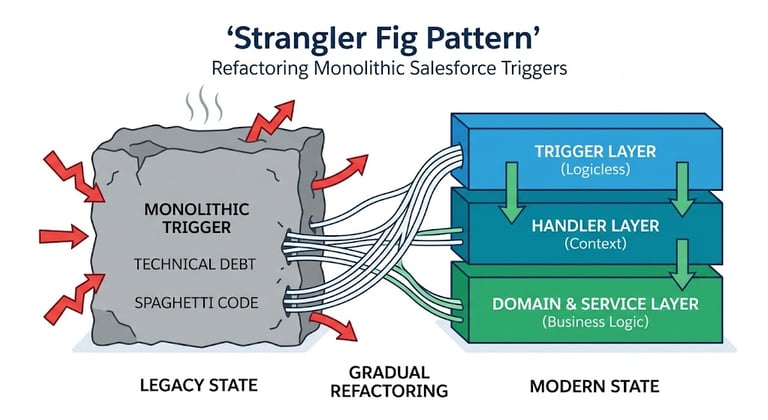
The Trigger: Should be logicless. Its only job is to delegate to a handler.
The Handler: Manages the context (Before Insert, After Update, etc.).
The Service/Domain Layer: Where the actual business logic lives.
4. The Migration Strategy: "The Strangulation Pattern"
In software engineering, the Strangler Fig Pattern involves gradually creating a new system around the edges of the old one, until the old one is eventually replaced. This is the safest way to refactor a Salesforce monolith.
Phase A: The Bridge
Create your new Trigger Handler and hook it into the existing trigger. At this stage, the trigger will have the "old" mess and a call to the "new" framework.
Phase B: Logic Extraction
Pick one specific business rule—for example, "Address Validation on Account." Extract that specific logic from the monolith, move it into a Domain Class, and invoke it through the new handler.
Phase C: Feature Flags (The Architect's Secret)
If the logic is particularly sensitive, use Custom Metadata or Custom Permissions as a "Feature Flag." This allows you to toggle the new logic on or off in production without a new deployment. If something goes wrong, you can revert to the legacy path in seconds.
5. Dealing with the "Context" Problem
One of the biggest pitfalls in monolithic triggers is the lack of a State Manager. Logic is often repeated because the developer didn't know if a calculation had already been performed in a previous step.
During your refactoring, implement a way to pass state. If you are using a modern framework, ensure your Service layer is idempotent—meaning it can be called multiple times without causing side effects or redundant SOQL calls.
6. The Human Element: Communicating the Value
Refactoring is a hard sell because it doesn't always result in a new "button" for the user to click. To get buy-in, you must speak the language of the business:
Speed to Market: "By cleaning this up, we can deliver the next three features in half the time."
Stability: "This will reduce our production errors by 40%."
Scalability: "The current code won't support the 500,000 new records we are importing next quarter."
Final Verdict
Refactoring a monolithic trigger isn't just about making the code look "pretty." It’s about building a foundation that allows the business to grow. It requires patience, a disciplined approach to testing, and the courage to admit that the way things were done five years ago isn't working today.
The best time to refactor was two years ago. The second best time is now.
Connect
Reach out for feedback or technical inquiries.
© 2026. All rights reserved.